Built with a fourth-generation Oregon farm family
What would you do with your evenings back?
Vineyard work changes shape all season: tying and pruning by the hour, hand picking by the piece, machine harvest after dark. Each punch is tied to a work area, so a pruning day and a harvest day read differently on the record.
No credit card required · 30-day trial of our top plan · Cancel anytime
Say where the work happened
When crew members also work in a winery or cellar, the location of the work can raise classification questions. Farm Timecard records where each punch happens. Your adviser decides how that work is classified.
- Geofenced clock-in by field, so a punch is tied to the block where the work was done.
- An overnight machine harvest scheduled as its own shift.
- Hand picking by the piece beside hourly tying and pruning, on one timecard.
How a pay period runs
01
Plan
Schedule the crew and set the day’s work.
02
Capture
Record hours, breaks and piece work in the field.
03
Review
Check timecards and rates, then approve the pay period.
04
Prepare
Get pay details and files ready for your payroll provider.

Inside Farm Timecard
Review the record before preparing files.
This is the punch detail screen, shown with demonstration data. Open an entry to see the punch and its edit history. Nothing is overwritten, so the office can see what changed before the hours go into a payroll file.
View the larger screenshot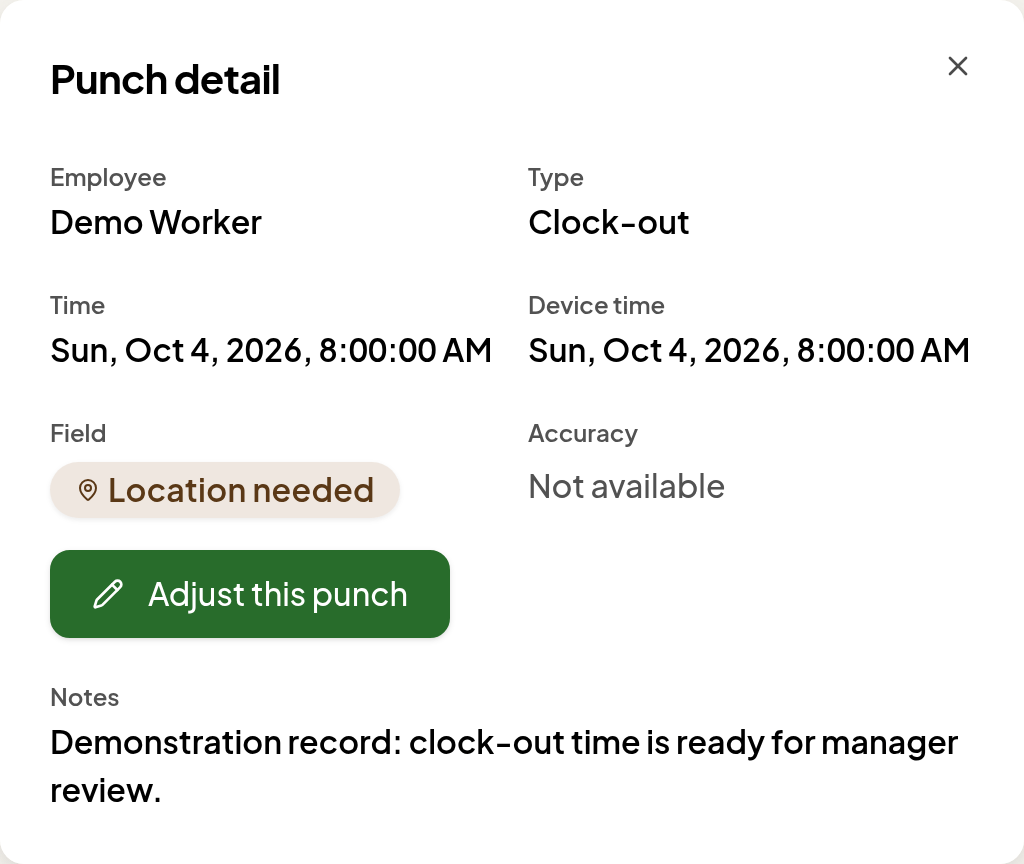
What we prepare, and what stays with your payroll team
We prepare payroll files and review summaries. Your payroll provider or payroll team handles taxes, net pay, payments and filings. Direct submission to payroll providers is unavailable. A download does not mean workers have been paid.
Which rules apply depends on the work, where it happens, the dates, your agreements and how each worker is classified. A farm category alone does not establish a rule or exemption, and local or program conditions can add more. These pages support your preparation. They are not a compliance guarantee or legal advice.
Questions to settle before you switch
- Does any of your crew also work in the winery or cellar?
- Who checks the corrections and approves the hours?
- What file or format does your payroll provider or bookkeeper need?
Pay math you can check, line by line.
For supported pay types, we work out minimum-wage make-up pay, piece pay and the overtime rate from the hours, piece counts and dated rates you record, and show each step. Review the result before it goes into a file. When two ways of figuring a worker's pay are compared, only the one selected is paid. This page does not calculate wages for you.
Worked pay examples and the new explanation reports are still being checked, so we have not published any yet. Ask whether they are ready for your workflow before you rely on them.
Explore your state and farm activity
Choose the tools your farm needs.
Which plan fits depends on how you pay your crew: by the hour, by the piece, or under H-2A. The pricing page shows what each plan includes.
Every new farm gets 30 days of our top plan with no credit card. When it ends you keep full use for 14 more days. After that your workers keep clocking in and you can still view and export your records until you choose a plan.
Oregon farms can estimate the overtime tax credit (AEOTC) and prepare its records on the Crew and Producer plans. The Basic plan does not include AEOTC. An estimate is not a tax filing, and credit eligibility depends on your farm.
No credit card required · 30-day trial of our top plan · Cancel anytime