Built to the specs of Seymour Dairy, a fourth-generation Oregon dairy
Oregon farm overtime drops to 40 hours on January 1, 2027.
Oregon farm overtime generally starts after 48 hours in a workweek in 2025 and 2026, and after 40 hours from January 1, 2027. We apply the change for you, including weeks that straddle it. Exemptions and the kind of work matter, so check yours with an adviser.
No credit card · 30 days of our top plan · Free after that
Overtime starts at 48 hours through 2026 and at 40 hours from 2027
In 2025 and 2026, Oregon agricultural overtime generally starts after 48 hours in a workweek. From January 1, 2027 it generally starts after 40. A worker who puts in 44 hours in one week is under the line in 2026 and has 4 overtime hours in 2027. Exemptions and the type of work matter, so check the dated BOLI guide and confirm your own obligations with an adviser.
- Confirm the workweek your farm uses, since overtime is counted week by week.
- Farm Timecard follows the phase-in for you, including weeks that straddle January 1, 2027.
- The Oregon overtime tax credit counts full-time-equivalent (FTE) workers over a year. That is not the same as the number of people on your crew today.
How a pay period runs
01
Plan
Schedule the crew and set the day’s work.
02
Capture
Record hours, breaks and piece work in the field.
03
Review
Check timecards and rates, then approve the pay period.
04
Prepare
Get pay details and files ready for your payroll provider.

Inside Farm Timecard
Review the record before preparing files.
This is the punch detail screen, shown with demonstration data. Open an entry to see the punch and its edit history. Nothing is overwritten, so the office can see what changed before the hours go into a payroll file.
View the larger screenshot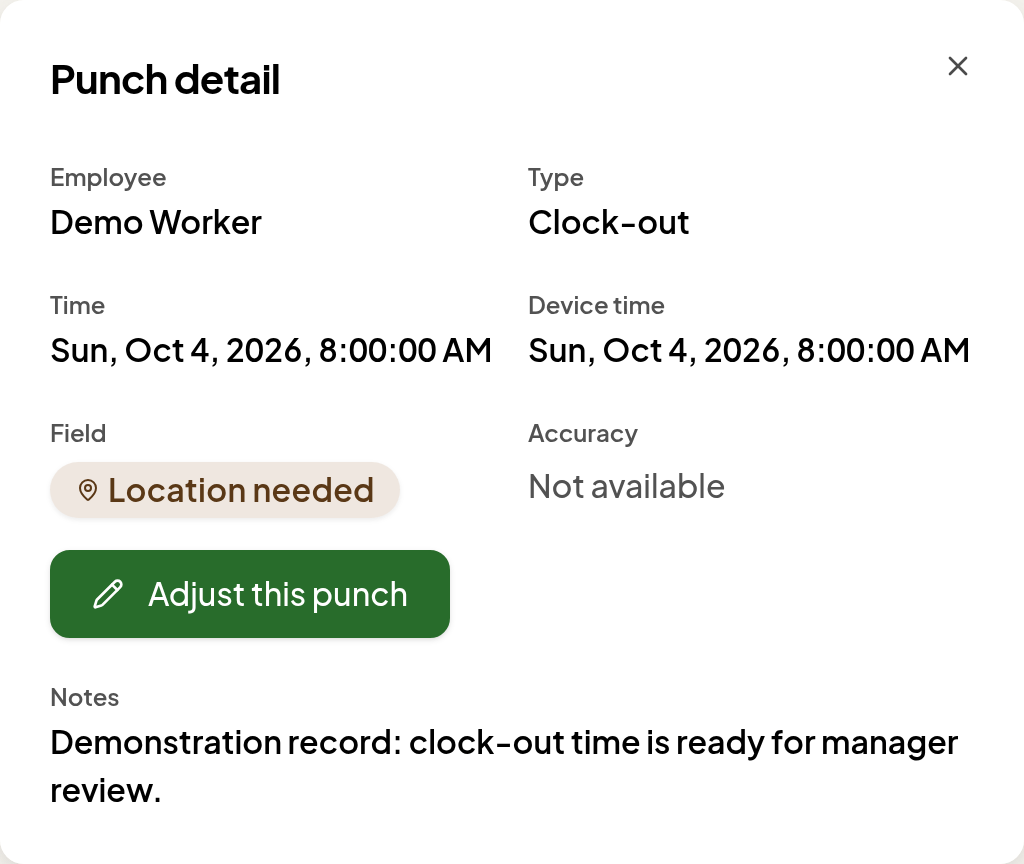
What we prepare, and what stays with your payroll team
We prepare payroll files and review summaries. Your payroll provider or payroll team handles taxes, net pay, payments and filings. Direct submission to payroll providers is unavailable. A download does not mean workers have been paid.
Which rules apply depends on the work, where it happens, the dates, your agreements and how each worker is classified. A farm category alone does not establish a rule or exemption, and local or program conditions can add more. These pages support your preparation. They are not a compliance guarantee or legal advice.
Questions to settle before you switch
- What workweek does your farm run, and which jobs does your adviser count as agricultural?
- Who checks the corrections and approves the hours?
- What file or format does your payroll provider or bookkeeper need?
Pay math you can check, line by line.
For supported pay types, we work out minimum-wage make-up pay, piece pay and the overtime rate from the hours, piece counts and dated rates you record, and show each step. Review the result before it goes into a file. When two ways of figuring a worker's pay are compared, only the one selected is paid. This page does not calculate wages for you.
Worked pay examples and the new explanation reports are still being checked, so we have not published any yet. Ask whether they are ready for your workflow before you rely on them.
Explore your state and farm activity
Choose the tools your farm needs.
Which plan fits depends on how you pay your crew: by the hour, by the piece, or under H-2A. The pricing page shows what each plan includes.
Every new farm gets 30 days of our top plan with no credit card. After that you move to the Free plan unless you choose a paid one.
Oregon farms can estimate the overtime tax credit (AEOTC) and prepare its records on every paid plan. The Free plan does not include AEOTC. An estimate is not a tax filing, and credit eligibility depends on your farm.
No credit card · 30 days of our top plan · Free after that